179. John 19:38–42 – The Paradox of the Burial
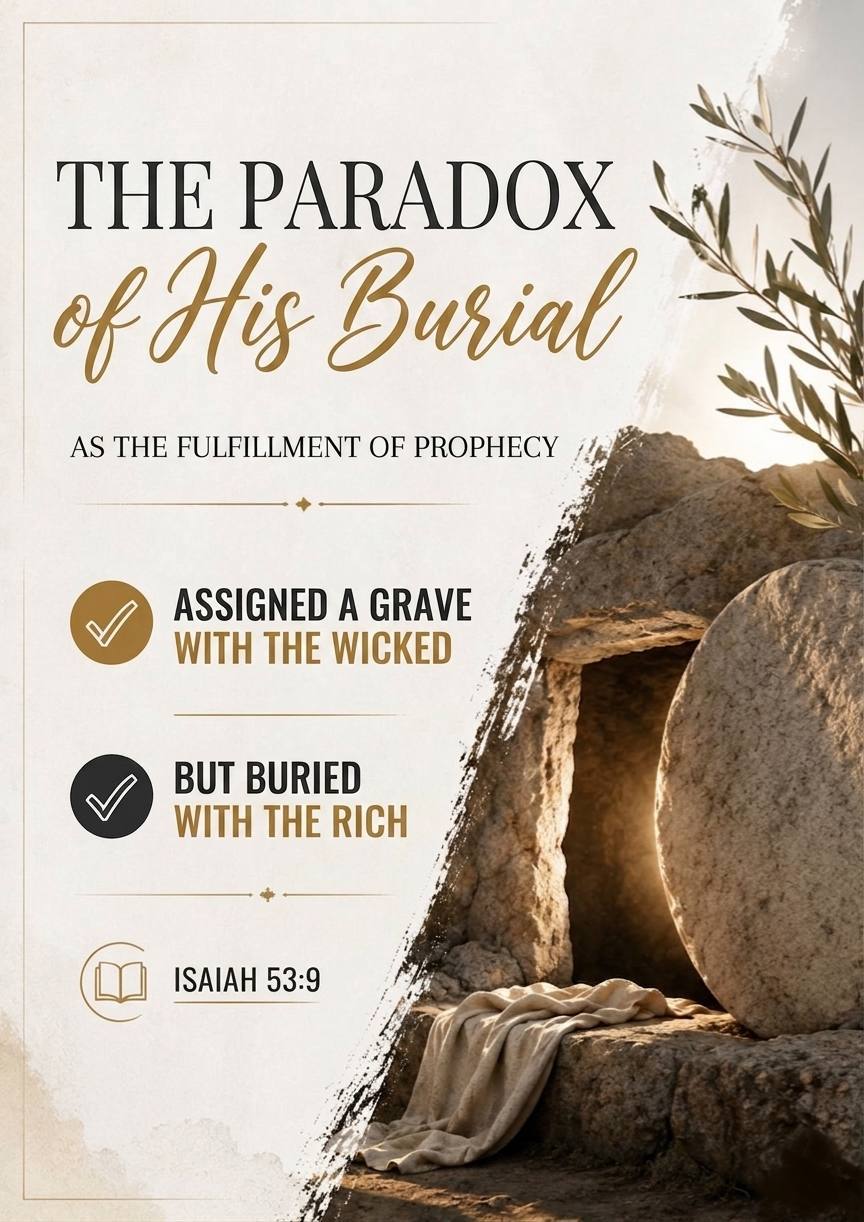

The Paradox of the Burial
John 19:38–42
📖 Biblical Text
38 After this, Joseph of Arimathea, being a disciple of Jesus, but secretly for fear of the Jews, asked Pilate that he might take away the body of Jesus; and Pilate gave him permission. So he came and took the body of Jesus.
39 And Nicodemus, who at first came to Jesus by night, also came, bringing a mixture of myrrh and aloes, about a hundred litras.
40 Then they took the body of Jesus, and bound it in strips of linen with the spices, as the custom of the Jews is to bury.
41 Now in the place where He was crucified there was a garden, and in the garden a new tomb in which no one had yet been laid.
42 So there they laid Jesus, because of the Jews’ Preparation Day, for the tomb was nearby.
⸻
📜 Isaiah’s Prophecy 700 Years Earlier
Hundreds of years before Christ was born, the prophet Isaiah wrote:
“And they made His grave with the wicked — but with the rich at His death…”
— Isaiah 53:9
This prophecy was written about 700 years before the crucifixion of Jesus. In Isaiah’s time, Roman crucifixion did not yet exist in its later well-known form. Executions were more commonly carried out through stoning, beheading, or other methods.
That is why Isaiah’s words do not sound like a vague attempt to “predict the Messiah’s fate,” but rather like a remarkably precise description of a paradox:
a shameful criminal’s death,
yet a rich man’s burial.
Even in Isaiah’s era, such a combination would have seemed highly unusual.
⸻
😶 The Secret Disciple Joseph of Arimathea
Joseph of Arimathea barely appears in the Gospels before Jesus’ burial. John writes that he was a secret disciple “for fear of the Jews.”
But after Christ’s death, this hidden disciple suddenly steps forward:
he goes to Pilate,
asks for the body,
and arranges the burial.
While many public disciples became afraid, the secret disciple became bold.
⸻
🪦 A Wealthy Tomb
This was not merely a “decent” grave.
Joseph’s tomb:
was new,
cut into rock,
and intended as a personal family burial place.
Such rock-cut tombs belonged to wealthy and influential people. Most people in Judea could never afford such a burial.
This was especially unusual for a crucified man, because criminals were normally buried:
without honor,
in common graves,
or very poorly.
Christ dies like a criminal, yet is placed in a tomb belonging to the upper class of society.
⸻
⚖️ Pilate’s Permission
After a Roman crucifixion, the body remained under Roman authority. No one could simply remove the body on their own.
Joseph had to:
gain access to Pontius Pilate,
officially request the body,
and receive permission.
Mark 15:44–45 shows that Pilate even verified Jesus’ death through the centurion.
The fulfillment of the prophecy also depended on the decision of a Roman governor.
⸻
🏛️ Pressure from the Sanhedrin
Joseph risked a great deal.
He was a member of the Sanhedrin — the very council that sought Jesus’ death. Supporting a crucified man could:
destroy his reputation,
create conflict with the religious elite,
and lead to rejection.
Yet despite the pressure, Joseph acts openly.
⸻
⏳ The Tomb Was Already Prepared
Events moved very quickly:
the Sabbath was approaching,
Passover was beginning,
and there was almost no time left.
Yet near Golgotha there was already a prepared new tomb.
While people thought everything was falling apart, God had already prepared a place for the prophecy to be fulfilled.
⸻
✨ A Convergence of Circumstances
When the whole picture is viewed together, the fulfillment of Isaiah 53:9 appears almost impossible.
At the same time, all of these things had to happen:
the Messiah had to die a shameful death,
the body could not be discarded,
a wealthy disciple had to appear,
he had to overcome fear,
a new tomb had to be nearby,
Pilate had to grant permission,
and everything had to happen before the Sabbath.
Too many unusual circumstances came together at once.
What looked like tragedy and defeat became yet another precise fulfillment of God’s prophecy.