174. John 19:17–22 – Titulus
Titulus
John 19:17–22
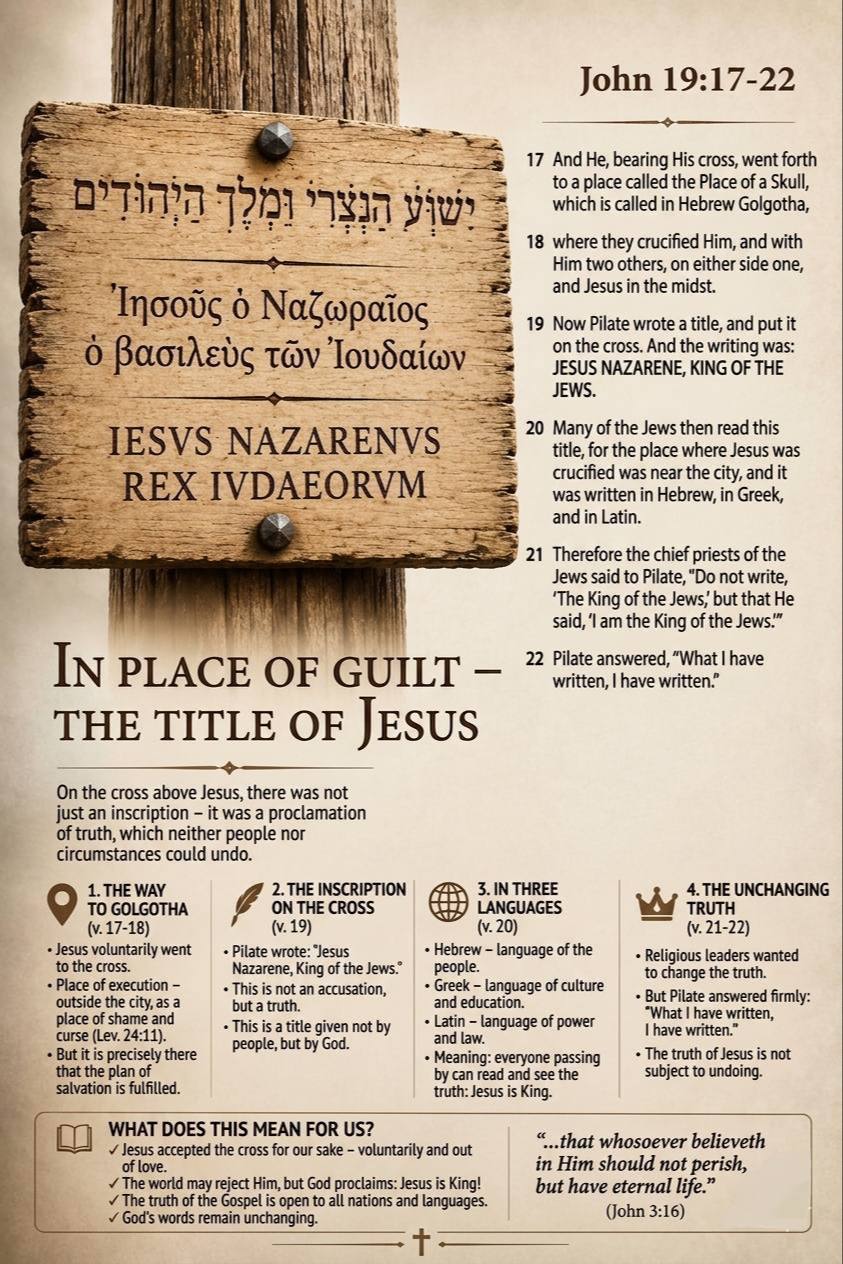
17 And He, bearing His cross, went out to a place called the Place of a Skull, which is called in Hebrew, Golgotha,
18 where they crucified Him, and two others with Him, one on either side, and Jesus in the center.
19 Now Pilate wrote a title and put it on the cross. And the writing was: “JESUS OF NAZARETH, THE KING OF THE JEWS.”
20 Then many of the Jews read this title, for the place where Jesus was crucified was near the city; and it was written in Hebrew, Greek, and Latin.
21 Therefore the chief priests of the Jews said to Pilate, “Do not write, ‘The King of the Jews,’ but, ‘He said, “I am the King of the Jews.”’”
22 Pilate answered, “What I have written, I have written.”
🪵 What Is a Titulus?
A titulus was a sign of accusation placed on a cross by the Romans. Normally it described the criminal’s offense:
thief,
rebel,
murderer.
But above Jesus was not a description of guilt, but a title:
“Jesus of Nazareth, King of the Jews.”
Instead of an accusation, the world unexpectedly saw a proclamation of who Christ truly is.
📜 The Uniqueness of Jesus’ Titulus
Jesus’ titulus was unusual. It was likely larger than ordinary execution signs:
a long text,
written in three languages,
containing many words.
Normally a titulus was short and practical. But this inscription became almost like a public announcement. People from many nations who came to Jerusalem for Passover could read it.
🌍 Three Languages and INRI
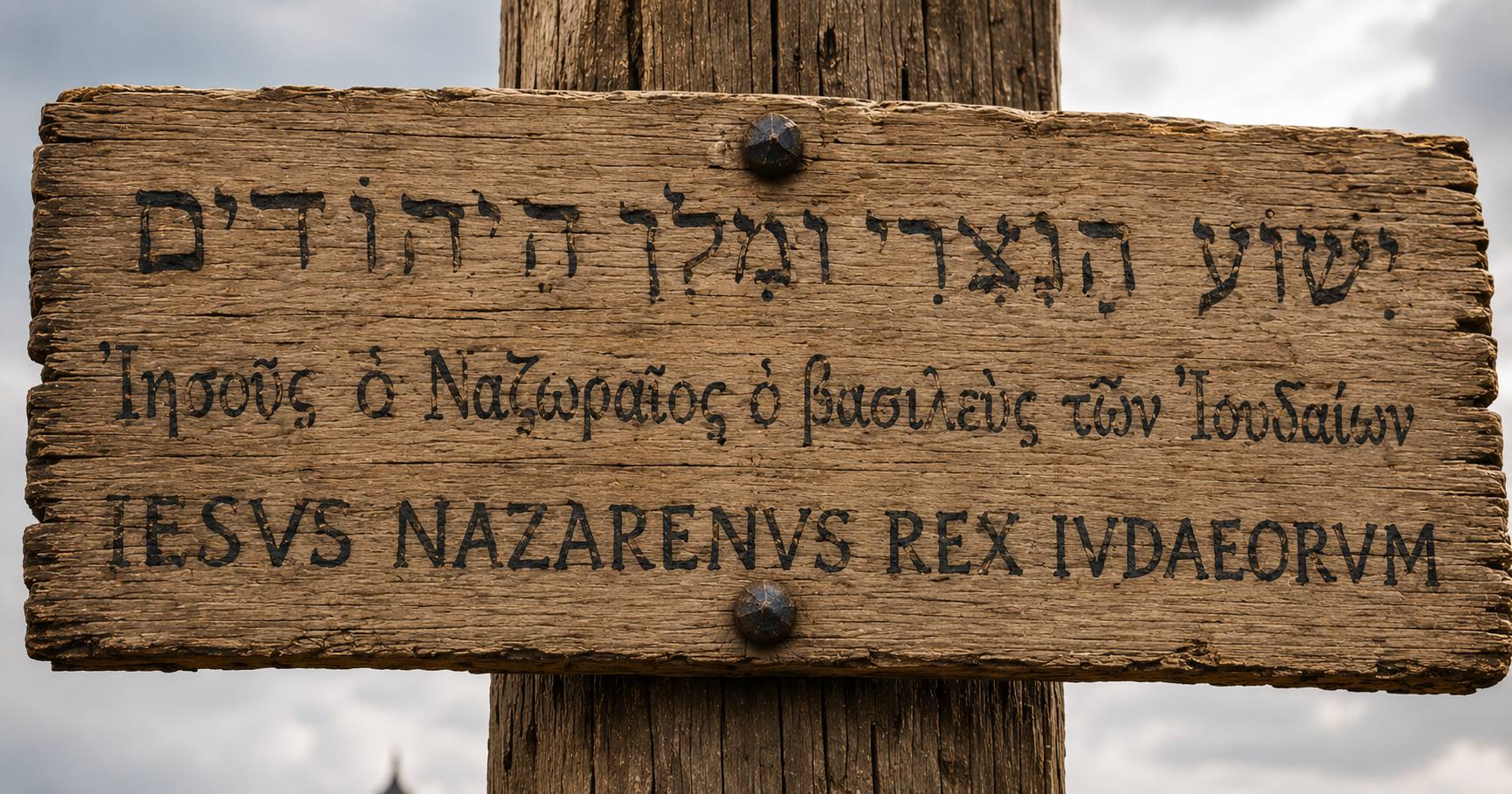
The inscription was written:
in Hebrew — the language of the local people and religion:
יֵשׁוּעַ הַנָּצְרִי וּמֶלֶךְ הַיְּהוּדִים
in Greek — the international language of culture and communication:
Ἰησοῦς ὁ Ναζωραῖος ὁ βασιλεὺς τῶν Ἰουδαίων
in Latin — the language of Roman authority and power:
IESVS NAZARENVS REX IVDAEORVM
Later in Christian tradition, the famous Latin abbreviation appeared:
INRI
which means:
Iesus Nazarenus Rex Iudaeorum
“Jesus of Nazareth, King of the Jews.”
In Orthodox tradition, a similar abbreviation is used:
ІНЦІ
Even the small upper bar on some crosses reminds believers of Christ’s titulus.
👑 An Attempt at Irony — A Proclamation of Truth
Pilate likely wanted:
to mock the chief priests,
to ridicule the idea of a “king,”
to humiliate Jesus.
But the opposite happened.
People tried to write an accusation, yet it became a proclamation of truth:
Christ truly is King.
Even a pagan ruler unwillingly became the one who announced Jesus’ title to the world.
🚶 The Tradition of Carrying the Titulus and Crossbeam
Some historians believe Jesus carried not the entire cross, but only the crossbeam. The vertical post may already have been standing at Golgotha.
In Roman tradition, the titulus was often:
carried in front of the condemned man,
or hung around his neck,
and later attached above his head on the cross.
This creates a powerful image:
while Jesus walked toward Golgotha, the inscription already went before Him:
“King of the Jews.”
👀 “Many Read the Inscription…”
The Gospel emphasizes:
“Many of the Jews read this title…”
People saw the same inscription, but responded differently:
some mocked,
some wanted the wording changed to something like “impostor,”
some wept as they watched Jesus suffer,
and some later believed in Him as Lord.
The titulus was written in several languages so many people could read it. Today, the Bible has been translated into hundreds of languages so people around the world can also learn who Jesus Christ is.
The Apostle John reveals many titles of Jesus:
Lamb of God,
Light of the World,
Good Shepherd,
The Way, the Truth, and the Life,
Lord and Savior.
Christ is not merely an innocent man who was crucified. He is King.
And each person must decide:
whether they are willing to recognize Christ as their King.