125. John 12:44-50 – The Last Sermon of Jesus to the People
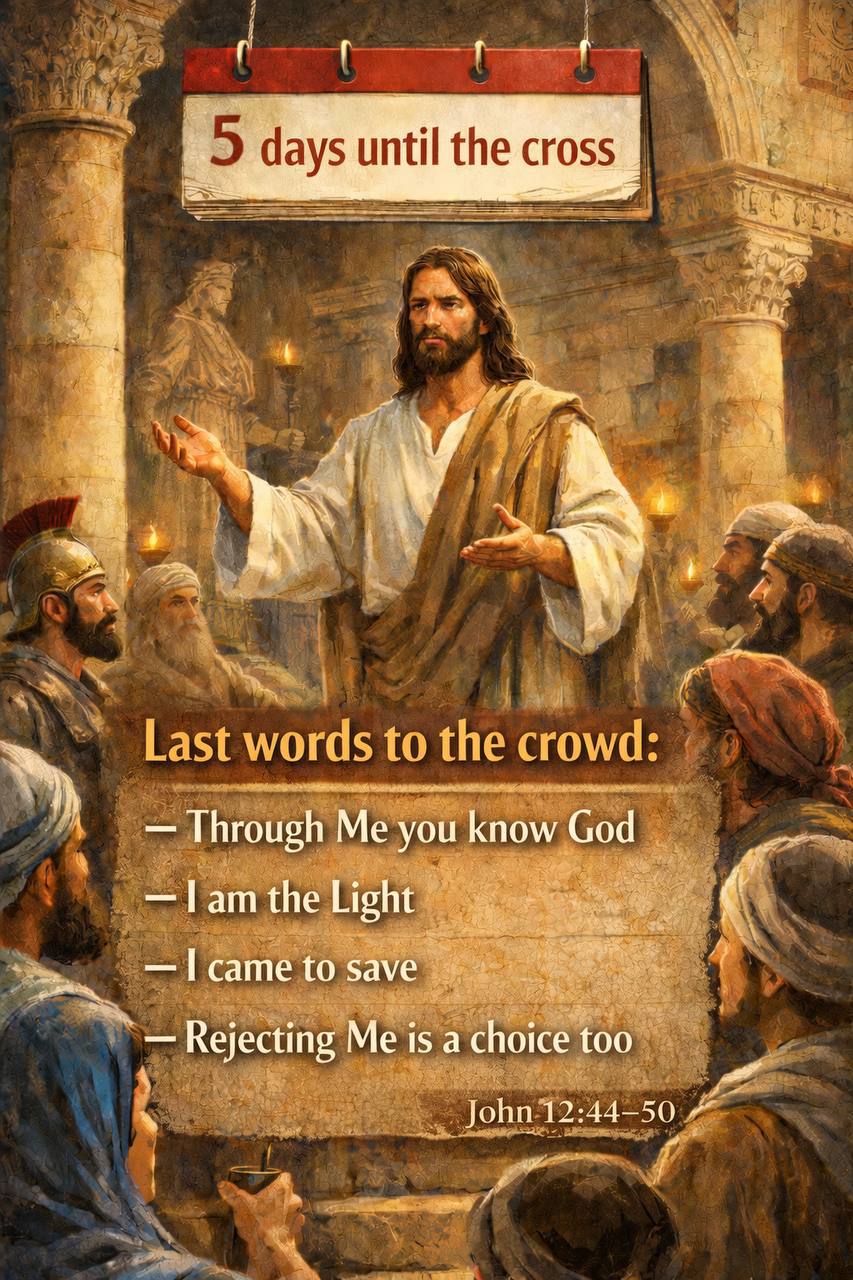
The Last Sermon of Jesus to the People
(John 12:44–50)
On Palm Sunday the crowd welcomes Jesus as King. Expectations are triumph, power, the beginning of a kingdom. But Christ does not accept glory the way people understand it. He does not strengthen His popularity or fuel the excitement. Instead, He uses His final days to speak the most important words. This is His last public sermon to the world.
 Biblical Text (John 12:44–50)
44 Then Jesus cried out and said, “He who believes in Me believes not in Me but in Him who sent Me.
45 And he who sees Me sees Him who sent Me.
46 I have come as a light into the world, that whoever believes in Me should not abide in darkness.
47 And if anyone hears My words and does not believe, I do not judge him; for I did not come to judge the world but to save the world.
48 He who rejects Me and does not receive My words has that which judges him—the word that I have spoken will judge him in the last day.
49 For I have not spoken on My own authority; but the Father who sent Me gave Me a command, what I should say and what I should speak.
50 And I know that His command is everlasting life. Therefore, whatever I speak, just as the Father has told Me, so I speak.”
 Not the acceptance of glory, but a final opportunity
The crowd is ready to proclaim Him King. But Jesus knows: in a few days these same people will stand silent at the cross. So instead of political promises, strengthening influence, or a celebratory speech, He gives the summary of the Gospel. Palm branches mean nothing if a person has not understood who stands before them.
 1. Through Christ, God is revealed
“He who believes in Me believes in Him who sent Me”
Christ leaves no neutral position. One cannot accept God while rejecting Jesus. He is not a messenger of ideas but the revelation of the Father Himself. The final sermon begins not with morality but with a Person.
 2. He is the Light, not merely a teacher
“I have come as a light into the world”
This is the last appearance of the theme of light in the Gospel. While Christ stands among the people, the time of decision remains. Soon night will come: arrest, trial, crucifixion. But for now the Light still stands before them.
 3. Jesus came to save the world
“I did not come to judge the world but to save the world”
Jesus does not accuse the crowd that will soon abandon Him. He still offers salvation. It is striking: in the final days before His death He does not defend Himself — He saves them.
 4. But refusal is also a decision
“The word… will judge him in the last day”
Judgment will not come because of lack of information. The people heard enough. They saw miracles, heard truth, observed Christ’s life. Now their response becomes a choice. Silence is also an answer. To postpone is to reject.
 5. His words are life
“His command is everlasting life” This is not philosophy and not a religious system. The words of Christ are the boundary between life and destruction. He does not merely add knowledge — He gives life.
 Main idea
On the day the people were ready to glorify Him as King, Jesus spoke not about glory but about salvation. He used the last opportunity to address them: revealing who He is, warning about the consequences, and offering life. In five days there would be the cross, but while the voice still sounds, it is the final call of light before the coming darkness.