169. John 18:28–32 – What Does It Mean to “Defile Yourself”?

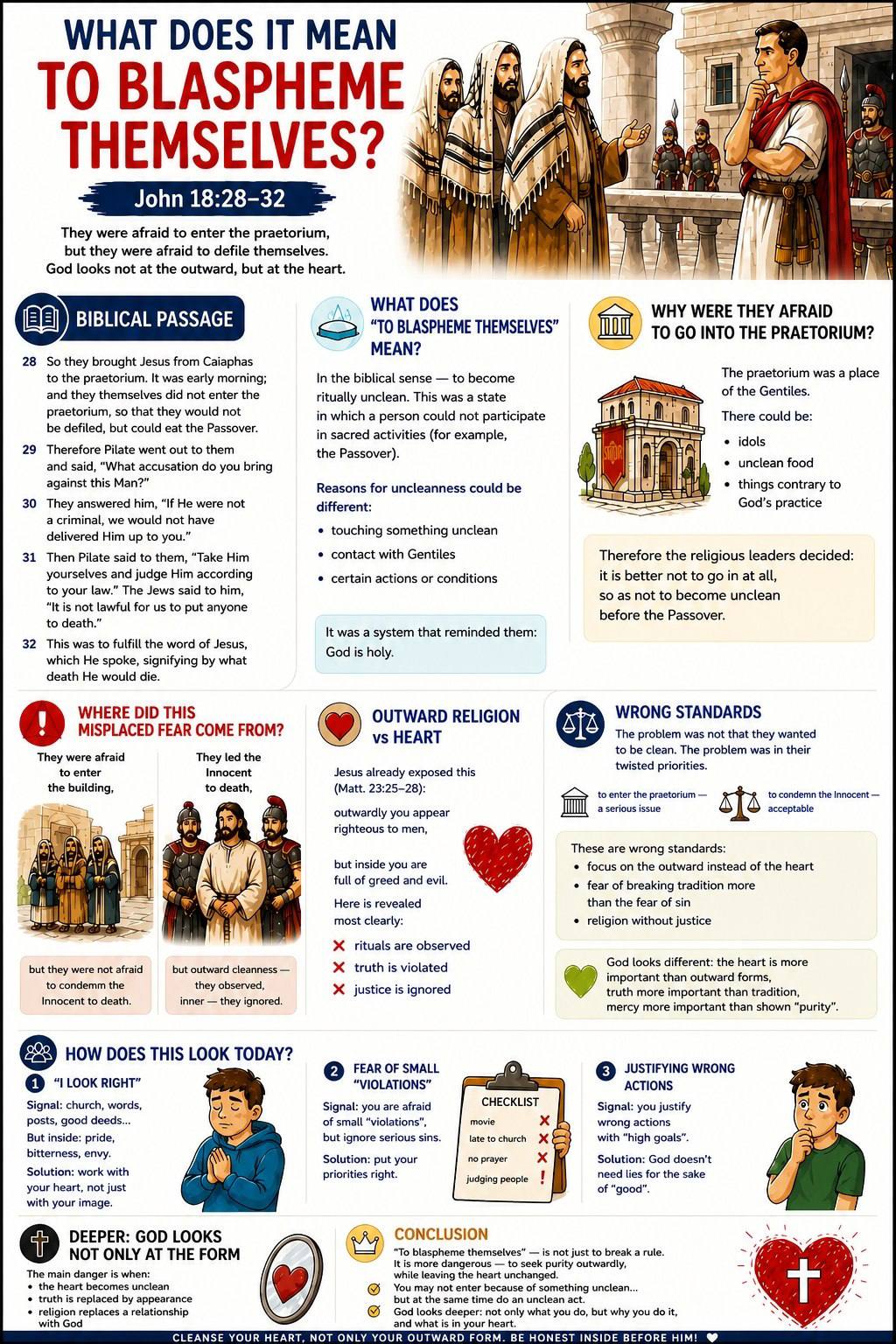
What Does It Mean to “Defile Yourself”?
John 18:28–32
📖 Bible Passage
Then they led Jesus from Caiaphas to the Praetorium, and it was early morning. But they themselves did not go into the Praetorium, lest they should be defiled, but that they might eat the Passover.
Pilate then went out to them and said, “What accusation do you bring against this Man?”
They answered and said to him, “If He were not an evildoer, we would not have delivered Him up to you.”
Then Pilate said to them, “You take Him and judge Him according to your law.” Therefore the Jews said to him, “It is not lawful for us to put anyone to death,”
that the saying of Jesus might be fulfilled which He spoke, signifying by what death He would die.
⸻
🏛️ The Praetorium — the Place of the Event
The Praetorium was not just one room, but an entire Roman complex where the Roman governor Pontius Pilate lived and worked. It included courtrooms, inner courtyards, soldiers’ quarters, and guard areas. In many ways, it functioned as a court, government office, and military headquarters all in one.
This is where Jesus was brought for the official Roman trial.
⸻
🧼 Why Was Entering It Considered Defiling?
For many Jews of that time, the house of a Gentile was considered ritually unclean. Inside the Praetorium there could have been:
pagan symbols and idols
unclean food
objects connected to Roman religious practices
Because of this, the religious leaders refused to enter so they would not become “unclean.”
It is important to understand that this was not mainly about moral sin, but about ritual purity — a condition connected to participation in religious celebrations.
⸻
🍞 Purity for Ritual, Not for God
John specifically explains their motivation:
“that they might eat the Passover”
Their focus was:
keeping the right to participate in the Passover meal
avoiding ritual contamination
This creates a shocking contrast:
they are worried about ceremonial purity while at the same time arranging the death of an innocent Man.
👉 Already here we can see that something in their spiritual priorities was deeply broken.
⸻
⚖️ Religious People Look Worse Than a Pagan Ruler
Ironically, in this scene the pagan Roman ruler Pontius Pilate sometimes appears morally better than the religious leaders.
Pilate:
tries to understand the accusation
does not see clear guilt in Jesus
later attempts several times to release Him
Yes, Pilate was far from a holy man. History describes him as a harsh ruler. But in this moment, the religious leaders appear even more hardened and aggressive than the pagan governor.
⸻
📏 Double Standards
They carefully protected:
ritual purity
religious tradition
outward cleanliness
But at the same time:
pressured the court
demanded the death of an innocent person
were spiritually far from God
👉 Outwardly “clean”
👉 Inwardly spiritually broken
This is the danger of double standards:
focusing on outward religion while ignoring the condition of the heart.
⸻
🔥 What Is Spiritual Purity for Us?
What matters more to us:
performing religious rituals
or
having a real relationship with God?
When we see someone missing church:
are we mainly annoyed that they are “not faithful enough”?
or
do we genuinely care about what may be happening in their life?
When we see someone dressed strangely:
do we first think about fixing their appearance?
or
about telling them about Christ?
God cares not only about outward form, but also about the heart.
⸻
✝️ True Spiritual Purity
True spiritual purity includes:
honesty
mercy
love
sincerity
justice
a relationship with God
A person can follow outward rules and still be far from God.
And another person may come to Him broken and imperfect, yet sincere — and be closer to God than a religious hypocrite.
⸻
💬 Conclusion
The religious leaders were afraid of becoming defiled by entering the Praetorium. But something far worse had already happened — their hearts had become defiled.
👉 They protected ritual purity while losing love, mercy, and justice.
This passage reminds us:
God looks deeper than outward behavior.
He cares not only about:
where we go
what rituals we keep
how we appear
He cares about what is happening inside our hearts.