101.John 10:7-10-Jesus — the Door for the Sheep
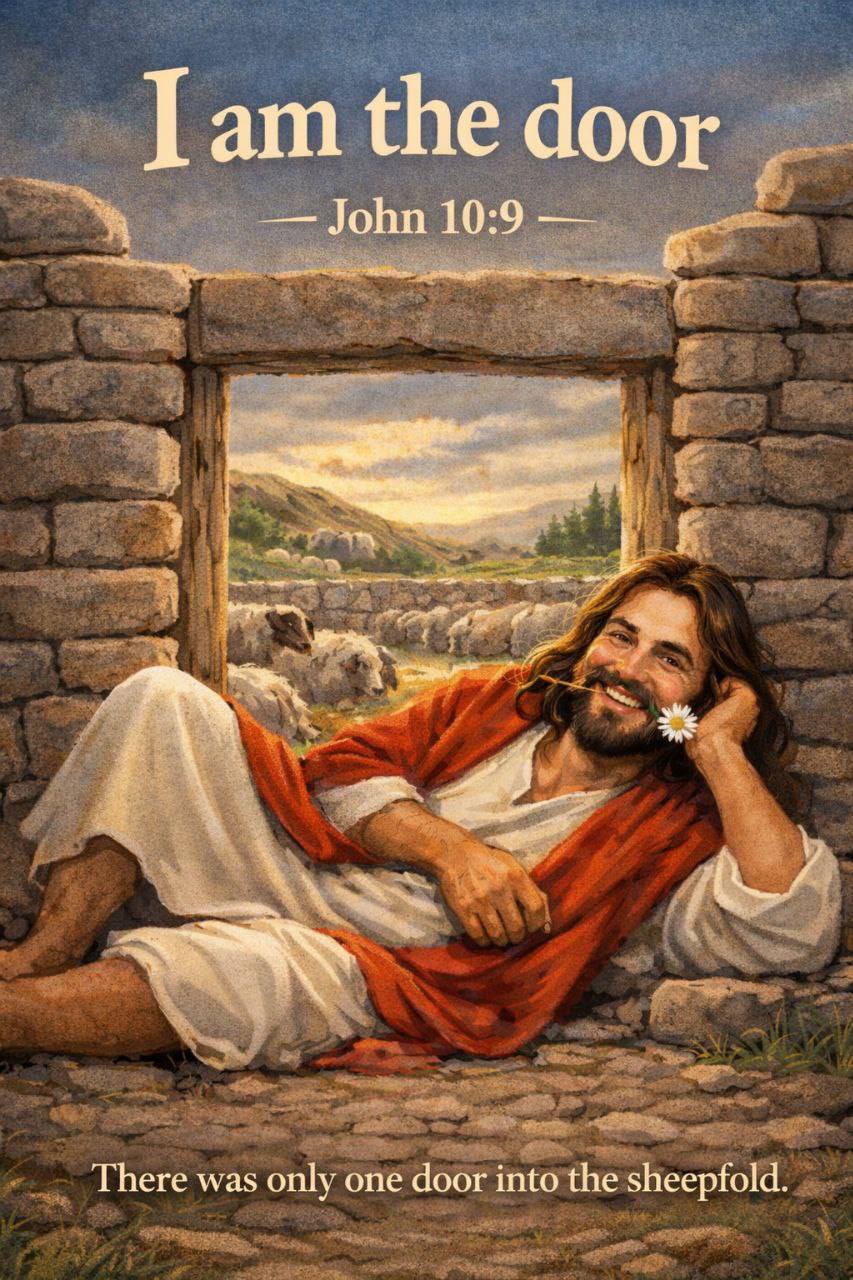
Jesus — the Door for the Sheep
John 10:7–10
Scripture Passage
7. So Jesus said again to them, “Truly, truly, I say to you, I am the door of the sheep.”
8. “All who came before Me are thieves and robbers, but the sheep did not listen to them.”
9. “I am the door. If anyone enters by Me, he will be saved, and will go in and out and find pasture.”
10. “The thief comes only to steal and kill and destroy. I came that they may have life and have it abundantly.”
The Door in Israelite Culture — Not Restriction, but Care
In biblical thinking, a door is not a prison bar or a lock meant to keep someone from escaping. It is a boundary of care and protection:
• protection from danger,
• respect for privacy,
• a clear entrance into a place where you are welcomed.
That is why the expression “Blessed shall you be when you come in, and blessed shall you be when you go out” meant a safe, whole, well-ordered life, not a loss of freedom. A door restricts evil, not the person.
The Image of the Shepherd and the Sheepfold
Sheepfolds in the time of Jesus were often:
• made of stone,
• without a roof,
• with one narrow entrance,
• without doors or locks.
At night the shepherd would lie across the opening, becoming the living door.
Security was provided not by construction, but by a person. A predator could not enter without confronting the shepherd. The sheep were not locked in — they were protected.
This is the image Jesus uses when He says: “I am the door.”
“Go In and Go Out” — Freedom Under Protection
The phrase “go in and go out” is a biblical idiom. It describes a normal, blessed life without fear:
• to go in — to be safe,
• to go out — to live, act, and serve,
• to find pasture — to be nourished and sustained.
Christ does not keep a person confined inside. He provides a safe entrance and a free exit.
A Few Interesting Facts About Doors
• The earliest doors were curtains — their purpose was not security but marking space.
• Wooden doors appeared before hinges: people first wanted to shut themselves in, and only later to open conveniently.
• In shepherds’ sheepfolds, doors disappeared again — security returned to the person of the shepherd.
• Modern bank doors are stronger than walls, yet they are still not fully trusted.
• The history of doors is the history of lost trust: from relationships → to technology. And Christ brings us back to the first.
Doors and Privacy: The Lesson from Noah
The story of Noah helps us see the difference between God’s protection and human boundaries.
1. The door of the ark withstood the storm.
The ark had one door — and Scripture emphasizes that the Lord Himself shut it (Genesis 7:16). Noah’s safety was not in the strength of the wood, but in the One who guarded the door.
2. Human curtains are fragile.
After the flood, Noah lived in a tent — without locks, only an implied boundary. The absence of a door was not permission to enter. Ham violated not a lock, but trust, entering without consent — effectively like a thief.
The Contrast of Two Purposes (John 10:10)
Jesus clearly contrasts Himself with the thief:
• the thief comes to steal, kill, and destroy,
• Christ comes to give life in abundance.
This is not about material wealth, but about the quality of life — with peace, meaning, and safety.
Conclusion
A door is care given a visible form. Jesus does not control the sheep — He stands between them and evil.