78. John 7:40-44 – Where was Christ from?
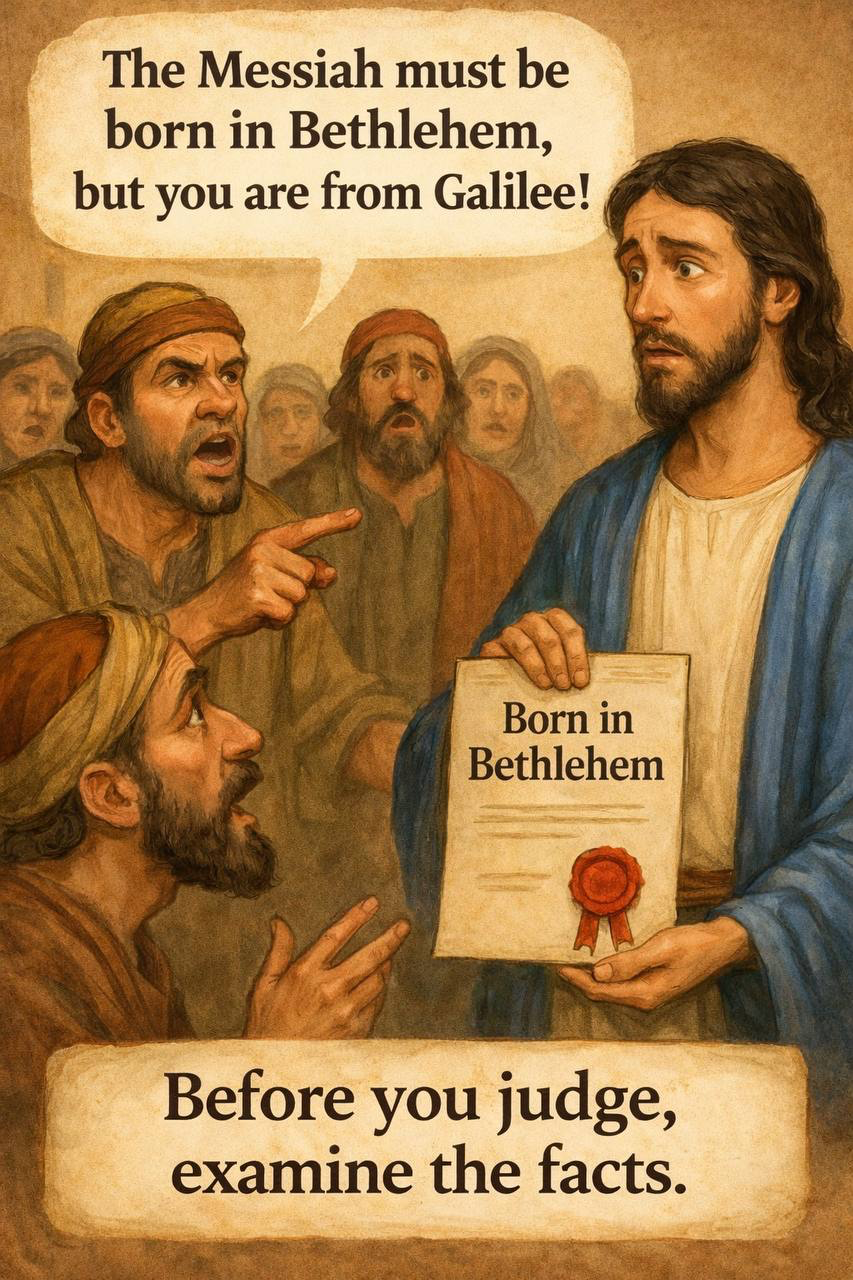
Before You Judge — Investigate the Facts
John 7:40–44
📖 Biblical Text
40 On hearing his words, some of the people said, “Surely this man is the Prophet.”
41 Others said, “He is the Messiah.” Still others asked, “How can the Messiah come from Galilee?”
42 “Does not Scripture say that the Messiah will come from David’s descendants and from Bethlehem, the town where David lived?”
43 Thus the people were divided because of Jesus.
44 Some wanted to seize him, but no one laid a hand on him.
When Confidence Replaces Truth
The people hear Jesus speak—and immediately they split into groups. Some recognize Him as a Prophet. Others believe He is the Messiah. Still others reject Him completely.
Yet none of these groups truly try to investigate.
Everyone speaks confidently. Everyone relies on their own conclusions.
And almost no one asks the one simple but decisive question.
⚠️ A Correct Verse — A Wrong Conclusion
The argument against Jesus sounds theologically solid:
The Messiah must come from the line of David and be born in Bethlehem.
That part is true.
The problem is not Scripture.
The problem is the assumption that Jesus does not meet this requirement.
Because Jesus grew up in Galilee, people automatically conclude He must have been born there.
A fact is replaced by an assumption.
An assumption becomes the basis for judgment.
👉 The truth was close—but no one bothered to verify it.
🔥 From Debate to an Attempt at Violence
John highlights that this disagreement led to division among the people.
Then comes a disturbing detail:
“Some wanted to seize him…”
Jesus is nearly arrested not because of a crime,
not because of evil,
not because of deception,
but because of a false conclusion made without investigation.
This is the climax of the passage:
superficial judgment becomes dangerous.
👉 If you judge without facts, you can end up condemning even Jesus.
📖 A Biblical Principle of Right Judgment
Scripture repeatedly emphasizes the same principle.
Proverbs 18:13
To answer before listening—that is folly and shame.
John 7:24
Stop judging by mere appearances, but instead judge correctly.
John 7:51
Does our law condemn a man without first hearing him to find out what he has been doing?
The Bible does not forbid discernment.
It forbids hasty, shallow, crowd-driven judgment.
Practical Application
Principles That Help Us Avoid Wrong Judgment
• Do not rush to conclusions.
Emotional speed is an enemy of truth.
• Check facts, not rumors.
Confidence does not equal correctness.
• Ask questions instead of attaching labels.
Questions open the door to truth; labels close it.
• Do not judge by appearance, background, or origin.
Life context is not a measure of truth.
• Listen before forming conclusions.
Judgment without listening is unjust.
• Do not yield to crowd pressure.
The majority can be loud—and wrong.
• First discuss complex issues in a small circle of thoughtful people.
Wisdom is more often found in calm dialogue than in the noise of the crowd.
• Accept that you may not know the full picture.
Humility protects us from error.
• Be careful with judgment.
Judgment always carries consequences.
🎯 Conclusion
The story in John 7 is a warning.
The people knew Scripture but did not investigate the facts.
They were confident—and they were wrong.
And because of superficial conclusions, they were ready to condemn the Messiah.
Before you judge — investigate the facts.
That is what the crowd failed to do.
And that is exactly what this passage teaches us.