80. John 8:1-6 – A Trap for Jesus
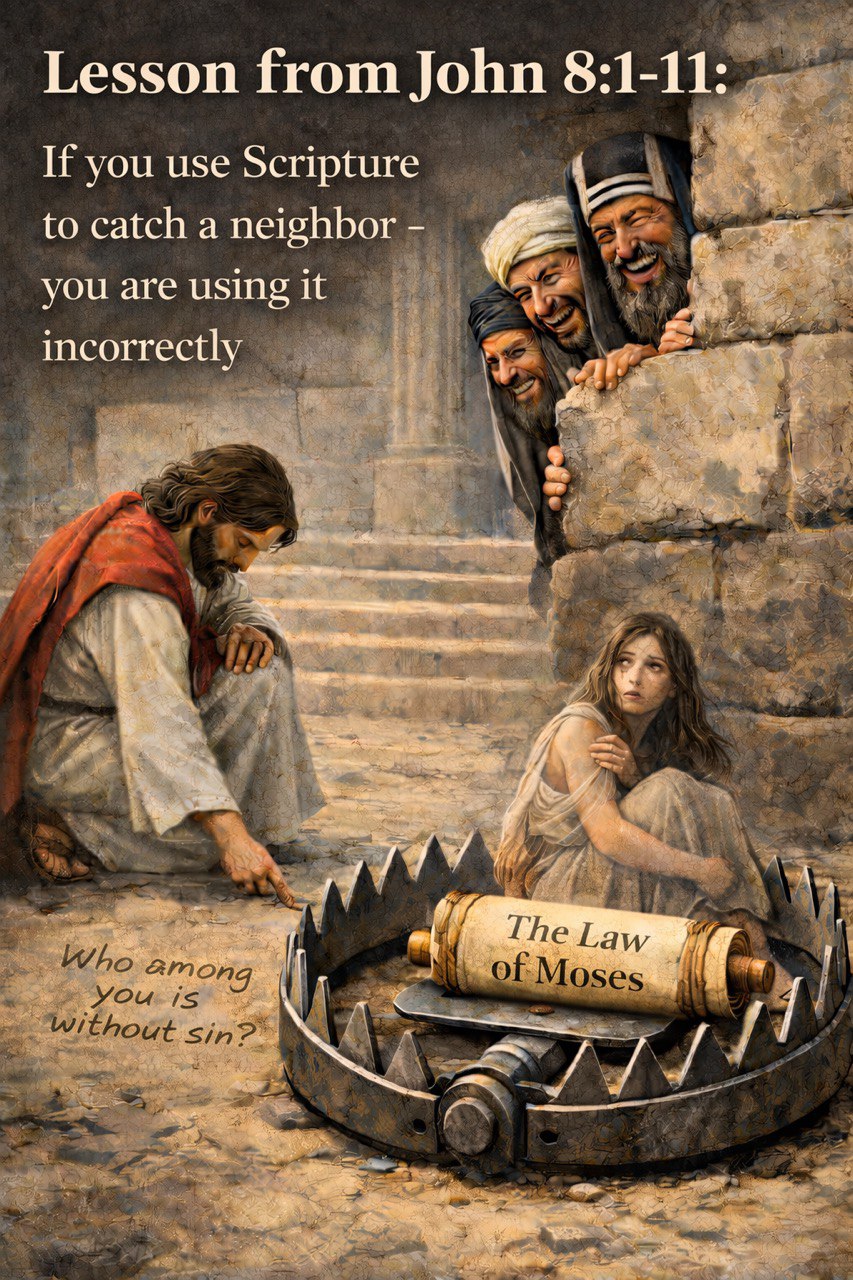
A Trap for Jesus
John 8:1–6
Sometimes Scripture is opened not to hear God, but to trap a person. The story at the beginning of John chapter 8 shows how religion can turn into an instrument of pressure, and truth into a snare.
Scripture Text: John 8:1–6
1. Jesus went to the Mount of Olives. 2. Early in the morning He came again into the temple, and all the people came to Him; and He sat down and taught them. 3. Then the scribes and the Pharisees brought to Him a woman caught in adultery, and having set her in the midst, 4. they said to Him, “Teacher, this woman was caught in adultery, in the very act. 5. Now Moses, in the Law, commanded us that such should be stoned. What do You say?” 6. They said this, testing Him, that they might have something of which to accuse Him. But Jesus stooped down and wrote on the ground with His finger.
The Scene in the Temple
The events take place in the temple — more precisely, in the courtyards of the temple complex. This was an open public space where rabbis taught the people and pilgrims gathered. The morning begins calmly : Jesus is sitting and teaching. He appears as a Teacher, not as a Judge.
But into this calm scene a conflict suddenly bursts . The scribes and Pharisees bring a woman and place her in the center. The very act of “setting her in the midst” turns her into an object of public pressure. She has no voice and no defense.
It is important to notice that according to the Law of Moses, responsibility lay on both participants in the sin. Yet only the woman stands before Jesus. This is the first sign that this is not about justice.
The Law as a Weapon
The Pharisees quote Scripture: “Moses commanded us to stone such women.” Formally, this is true. But truth torn out of its context becomes a weapon .
John clearly reveals their motive: they said this to test Jesus, so that they might accuse Him. This is not a question asked in search of truth, but a carefully prepared trap. Any answer could be used against Him — either to accuse Him of breaking the Law or to report Him to the Roman authorities.
The Law is used not for healing, but for pressure. A person becomes bait.
The Pause Jesus Makes
In response, Jesus does not enter into an argument. He makes a pause : He stoops down and writes with His finger on the ground. This action is repeated twice. John does not tell us what He wrote, because the focus is not on the content, but on the moment.
Jesus refuses to play by the rules of the provocation. He does not accept the imposed framework of the conflict and does not turn the temple into an arena of public humiliation. While He writes in the dust, the tension fades. Stones do not fly . Conscience is given space to speak.
This pause breaks the trap more powerfully than any argument and shows that true authority is not always expressed in an immediate response.
Pause and Avoiding Eye Contact in Modern Psychology
Interestingly, what Jesus does in this scene aligns with what today would be called de-escalation of conflict. Intense and prolonged eye contact often increases confrontation and a struggle for dominance. A pause and the avoidance of a direct stare, on the other hand, reduce tension and interrupt impulsive reactions.
It is important to emphasize: the Gospel does not present this as a “technique.” It is not manipulation. It is wisdom and inner freedom. Jesus does not avoid responsibility, but neither does He exert pressure through authority. Modern psychology simply puts words to what happens naturally in this scene: the pause creates space in which aggression subsides and conscience begins to work.
The Essence of the Trap
The Pharisees attempt to use three things as weapons:
Scripture — to justify violence,
the temple — as a stage for pressure,
a human being — as bait. Jesus shows that the Law without mercy loses its purpose, and truth separated from love ceases to be truth for a person.
Religious Bullying
Religious bullying is the manipulation of Scripture in order to trap one’s neighbor. Verses are used not to help, but to apply pressure. Outwardly everything may look pious, but the goal is not restoration — it is accusation.
In John 8, the problem is not that the Pharisees quote the Law, but why they do it. Scripture without love turns into a stone. That is why Jesus refuses to answer verse with verse and deprives this mechanism of its power.
Practical Application: When Scripture Becomes a Trap
The story of John 8 is repeated whenever the Bible is used not as light , but as a snare.
The Bible as a Turnstile. “If you are a real Christian, you must…”
The Pulpit with a Target. Public statements without names, but with a clear direction.
A Verse Without Context. One line instead of the whole story.
Truth at the Wrong Time. Right words spoken at the wrong moment.
A Verse as the Final Argument. Not to help, but to win.
In all these cases, the person stops being the goal. Scripture is no longer used for healing, but for pressure.
Before Referring to the Bible
Jesus makes a pause first, and only then speaks. This is an important guideline for us as well.
Listen to the situation to the end.
Do not respond to emotion with a Bible reference.
Ask a clarifying question — it can help more than a correct quote.
Ask yourself about your goal: to help or to prove yourself right.
Remember timing — truth spoken too early can wound.
Conclusion
The Pharisees came to Jesus with a trap and left without an accusation. The woman came condemned and received a chance for a new life. Because Jesus does not use Scripture as a weapon. He restores the Law to its heart and shows that truth always walks together with mercy.