95. John 9:18-23 – Passing the Buck — When Fear Defeats Responsibility
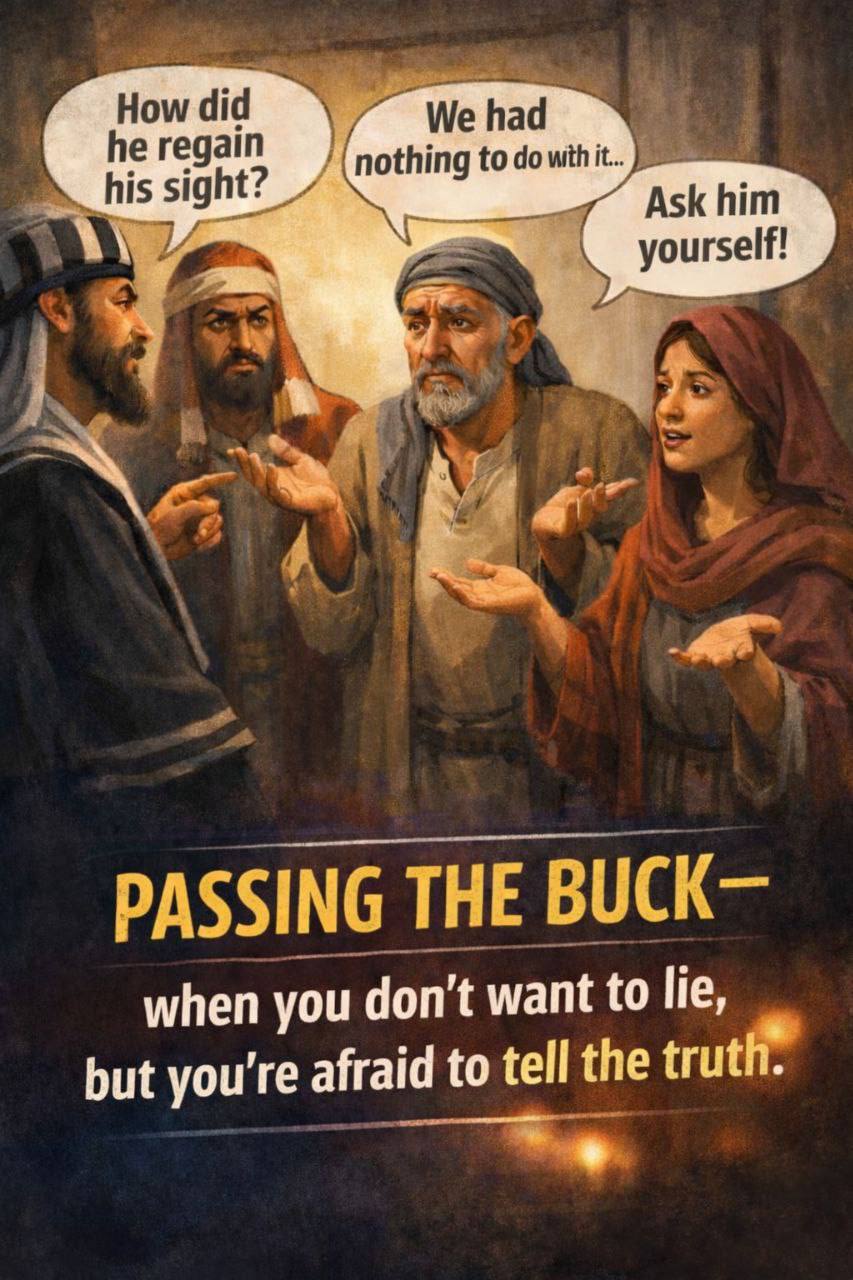
Passing the Buck — When Fear Defeats Responsibility
John 9:18–23
18. But the Jews did not believe concerning him, that he had been blind and received his sight, until they called the parents of him that had received his sight.
19. And they asked them, saying, Is this your son, who ye say was born blind? how then doth he now see?
20. His parents answered them and said, We know that this is our son, and that he was born blind:
21. But by what means he now seeth, we know not; or who hath opened his eyes, we know not: he is of age; ask him: he shall speak for himself.
22. These words spake his parents, because they feared the Jews: for the Jews had agreed already, that if any man did confess that he was Christ, he should be put out of the synagogue.
23. Therefore said his parents, He is of age; ask him.
What Does “Passing the Buck” Mean?
To pass the buck means to shift responsibility without denying the facts. It is neither lying nor silence . It is a way of speaking where enough is said to avoid falsehood, but not enough to take responsibility for what truly matters.
The expression itself comes from railway imagery : a switch redirects a train onto a different track. The train does not change—but its direction does. In the same way, the event remains real, but responsibility is deliberately redirected.
The parents of the blind man confirm the facts, yet intentionally remove the central Name from the story. Truth is fragmented so that the cost of truth does not fall on them.
Why Did They Do This?
The Gospel explains it plainly:
“because they feared the Jews” (v. 22).
In modern terms, this would look like someone being blocked on social media, isolated from communication, restricted in access to education, and targeted by damaging rumors.
Formally, the person is free . In reality, they drop out of life.
“Passing the Buck” as a Biblical Pattern
This mechanism appears repeatedly in Scripture:
• Adam speaks truth, but shifts blame .
• Aaron describes the process while hiding the decision .
• Pilate washes his hands, transferring responsibility .
• The parents speak facts while hiding the core issue .
In every case:
• the truth is known ;
• lies are not used ;
• responsibility is deliberately displaced .
Passing the buck is when a person refuses to take responsibility for their own words.
Where We See This Today
Passing the buck has become normal:
• in families — when focus shifts from words to reactions;
• at work — “I’m just following orders”;
• in spiritual settings — “God will sort it out”;
• on social media — “I’m just sharing”;
• within ourselves — “now is not the time.”
It almost always sounds reasonable and almost always preserves safety , but it always leads away from responsibility .
The Alternative to Passing the Buck
Scripture shows a different path — responsibility without masks:
• “I have sinned” — David;
• “I was blind, now I see” — the healed man;
• “We cannot but speak” — the apostles.
Do not fragment the truth.
Do not hide the essential.
Do not explain before you acknowledge.
Conclusion
Truth may be known, but the path of responsibility is still a choice.
Passing the buck preserves safety. Responsibility opens the way to light.
John 9 leaves us with a question: what is more valuable to us when truth has a cost?