93. John 8:6-12 – Obedience Is More Important Than Understanding
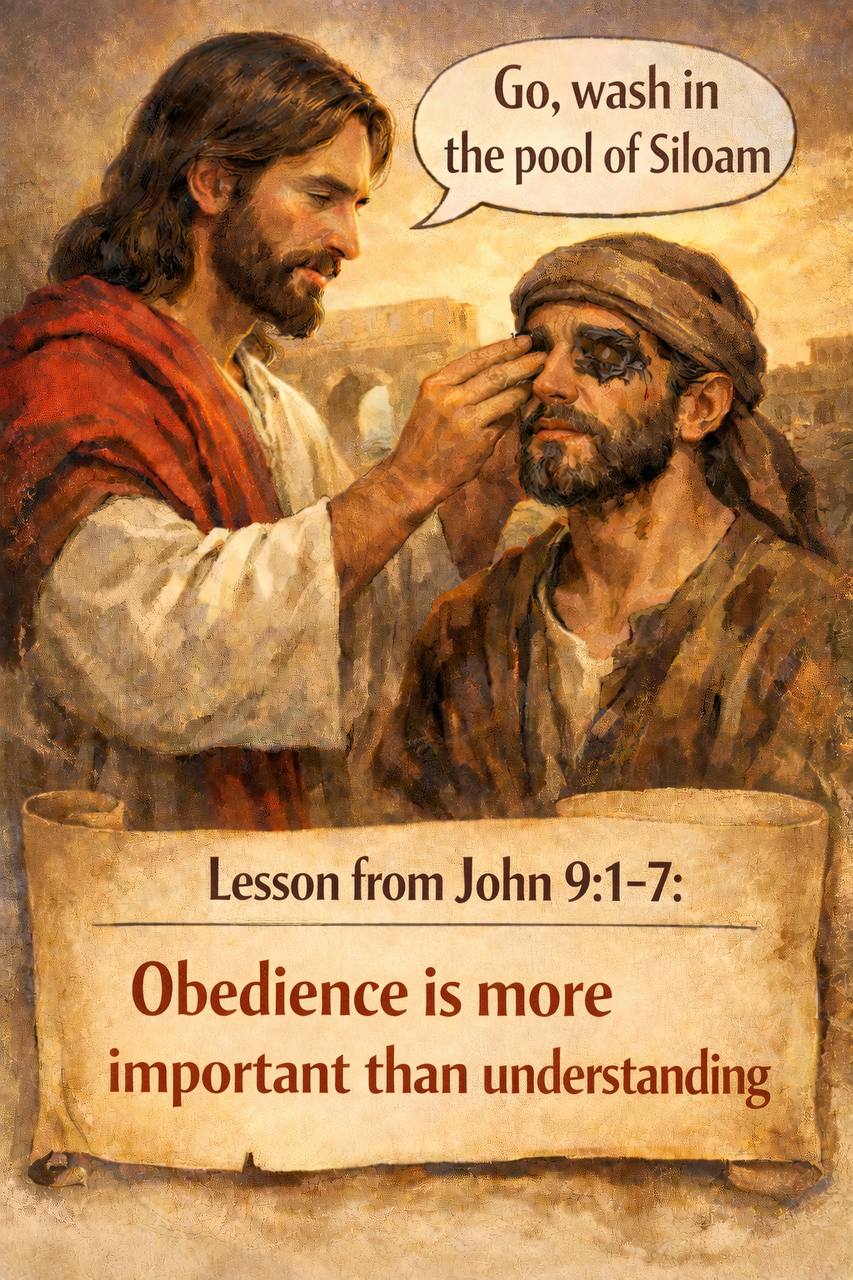
Obedience Is More Important Than Understanding
(John 9:6–12)
Biblical Passage
6. After saying this, Jesus spat on the ground, made mud with the saliva, and spread the mud on the man’s eyes.
7. “Go,” He told him, “wash in the Pool of Siloam” (this word means “Sent”). So the man went and washed, and came home seeing.
8. His neighbors and those who had formerly seen him begging asked, “Isn’t this the same man who used to sit and beg?”
9. Some claimed that he was. Others said, “No, he only looks like him.” But he himself insisted, “I am the man.”
10. “How then were your eyes opened?” they asked.
11. He replied, “The man they call Jesus made some mud and put it on my eyes. He told me to go to Siloam and wash. So I went and washed, and then I could see.”
12. “Where is this man?” they asked him. “I don’t know,” he said.
Obedience Without Understanding
Jesus acts in an unexpected way. He uses dirt and saliva, applies it to the blind man’s eyes, and does not heal him immediately. Instead of an instant miracle, He gives a command to go. The blind man receives no explanation—no reason for the mud, no logic behind Siloam, no promise of the outcome.
Yet he does not argue. He does not demand clarity. He simply obeys. This story begins not with a miracle, but with trust.
A Walk Through the City
From the temple area to the Pool of Siloam was a walk through a busy part of Jerusalem—about 600–700 meters along crowded streets. The man walked through the city still blind, with mud on his eyes.
In that culture, people watched one another closely, noticed what was unusual, and openly discussed what they saw. He was seen. He may have been mocked. He may have been questioned. Obedience looked awkward and uncomfortable—until God finished His work.
Many Witnesses of the Miracle
The Gospel emphasizes that “neighbors and those who had seen him before” recognized him. These were not strangers, but people who knew him as a blind beggar. The city saw him leave blind and return seeing.
The miracle became a public fact. It could not be hidden, embellished, or explained away as coincidence. God made the path of obedience visible before He made the result undeniable.
A Simple Testimony
When asked how he was healed, the man offers no theories. He simply recounts what happened: Jesus acted, Jesus spoke, I went, I washed, I can see. It is a testimony without complex explanations, but with undeniable truth.
Truth is often most powerful when it is spoken plainly.
He Came Back
After receiving his sight, the man does not disappear. He remains in the same context where Jesus was and becomes part of what follows. The miracle was not the end of his journey—it was the beginning of questioning, tension, and witness.
An encounter with Christ does not remove a person from reality, but gives them a firm place to stand within it.
Conclusion
• God does not always explain how He works, but He expects trust; the blind man did not understand the path, yet he obeyed Christ, and that obedience led him to sight—first physical, and then spiritual.